The Best Case Chain Paradox Why Five Easy Dinners Mathematically Guarantee A Broken Week And Why The 2 Plus 1 Strategy Is A Pooled Time Buffer Instead Of Five Private Optimisms
Why five easy dinners break your week and how the 2+1 strategy uses one pooled freezer buffer to defeat the kitchen planning fallacy.
The Best-Case Chain Paradox: Why Five "Easy" Dinners Mathematically Guarantee a Broken Week, and Why the 2+1 Strategy Is a Pooled Time Buffer Instead of Five Private Optimisms
The Kitchen's Planning Fallacy: A Week of Optimism, a Nightmare of Reality

In the kitchen, as in life, we plan with the best of intentions. We look at a recipe, see "30 minutes" under "Total Time," and schedule our week accordingly. But as any experienced cook knows, the gap between plan and reality is vast. This isn't a failure of willpower or organization; it's a fundamental miscalculation rooted in a cognitive bias known as the planning fallacy.
The Science Behind the Bias
The planning fallacy, first identified by Daniel Kahneman and Amos Tversky, describes our tendency to underestimate the time, costs, and risks of future actions while overestimating our ability to control events. In the canonical study by Buehler, Griffin, and Ross (1994), students predicted their thesis would take 33.9 days and it took 55.5. Only 29.7% finished by their own predicted date. Even when asked to imagine everything going as badly as possible, they averaged 48.6 days and only 48.7% beat their own worst case. This bias isn't limited to students or academics. It's a universal human trait that affects everyone, from home cooks to government planners.
"The planning fallacy is not a minor, occasional error. It is a systematic, predictable, and pervasive feature of human cognition." - Daniel Kahneman, Thinking, Fast and Slow
The Best-Case Chain: When Optimism Breeds Frustration
In the kitchen, the planning fallacy manifests as the Best-Case Chain: a week of dinners planned at their optimistic best, with no room for reality. If a single dinner has a roughly 30% chance of landing on schedule, then a five-dinner plan has 0.297 ≈ 0.2% chance of surviving intact. Even at a generous coin-flip 50% per night, a week is 3.1%. This isn't a minor inconvenience; it's a structural failure that dooms our plans to break, usually on Wednesday, Thursday, or Friday, when energy is lowest and the failure becomes takeout.
The Hidden Time: Where Our Plans Go Wrong
But why are our plans so optimistic? Because we ignore the hidden time, the unlisted minutes that recipes never account for. A recent analysis by Cosmo Appliances (2026) itemizes these costs:
-
Decision Time: Standing at the open refrigerator deciding takes 5–10 minutes.
-
Retrieval Time: Gathering ingredients across pantry, fridge, freezer, and spice drawer runs ~5 minutes for ingredients plus ~5 for tools/pans.
-
Prep Time: Professional knife speed and mise en place assumptions inflate prep time by 10–15 minutes.
-
Cooking Time: Residential equipment variance adds 5–10 minutes.
-
Sequential Execution: Assuming parallel workflow where none exists adds 5 minutes.
-
Plating and Cleanup: Post-meal tasks add 5–10 minutes.
These omissions total ~45 unlisted minutes, making a claimed 30-minute recipe really ~75–90. Until recipe timing is honest, assume advertised time needs a 50% buffer for real-world execution.
"The kitchen is a place of hope and optimism, but it's also a place of reality. And the reality is, we're not professional chefs with infinite time and resources." -

The Money Frame: The True Cost of Our Optimism
The planning fallacy isn't just frustrating; it's expensive. The U.S. Bureau of Labor Statistics (2025) reports Americans spend an average of 0.71 hours per day on food preparation and cleanup, roughly 260 hours a year. At a conservative wage estimate of $15/hour, that's $3,900 annually. But we're not just overestimating time; we're underestimating it. A 15-minute underestimation per dinner is 54 hours a year per cook, or $770 at that wage. Multiply that by the 128 million households in the U.S. (U.S. Census Bureau, 2020), and our optimism costs the nation billions.
The Fix: From Five Private Optimisms to One Pooled Time Buffer
So, how do we break the Best-Case Chain? The answer lies in buffer management, a concept from industrial scheduling science. Traditional planning hides safety inside every task estimate, which produces three failures: the padding is invisible, it gets consumed by early starts and multitasking, and it is never tracked. The Theory of Constraints answer is to strip padding out of each individual task, use the aggressive-but-achievable most-likely duration, and pool all of that protection into one visible, named buffer at the end of the chain (plus feeding buffers at merge points).
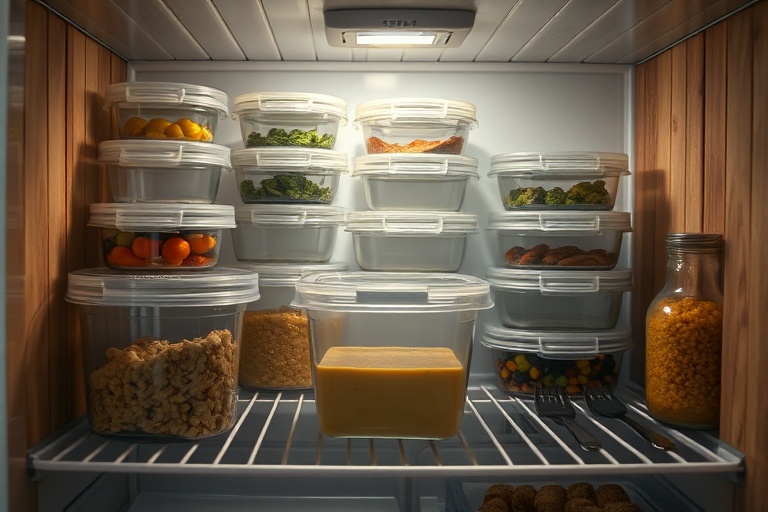
This maps onto the 2+1 Strategy with uncanny precision: two fresh core proteins are the critical chain run at honest, unpadded time; the freezer-breaker is the pooled project buffer. It's not backup food; it's time held in a named, visible place so that when night three overruns by 40 minutes (it will), the schedule absorbs it without renegotiating the entire week, without a shopping trip, and without a willpower decision at 6:12 p.m. The meal plan stops being five promises and becomes one promise plus one reserve.
"The freezer breaker isn't just a backup meal; it's a time buffer, a safety net, a hedge against the planning fallacy. It's the key to breaking the Best-Case Chain." -
Debiasing the Kitchen: Two Evidence-Based Tools
Breaking the Best-Case Chain isn't just about math; it's about psychology. Here are two evidence-based tools to debias your kitchen:
-
Reference-Class Forecasting / The Outside View: Base next week's estimate on how long this recipe took you, and adopt the "double the estimate for any task involving finding things" rule. Keep a kitchen log to track your actual times and use them to inform your future plans.
-
Implementation Intentions: Form if-then plans to reduce interruptions and improve behavior. The 2024 Sheeran, Listrom & Gollwitzer meta-analysis of 642 independent tests found forming if-then plans improved thinking, feelings, and behavior with small-to-moderate effects, and prior work showed the planning fallacy bias shrinks specifically because those plans reduce interruptions. So, if dinner is running late or a protein is unappetizing, then drop to the freezer breaker.
The Time Ledger: Honest Timing for Honest Planning
Here's a practical tool to apply the above insights: the Time Ledger. Use it to estimate your dinners honestly and plan your week realistically.
| Task | Average Time (minutes) |
|---|---|
| Decision | 7.5 |
| Retrieval | 5 |
| Prep Overrun | 12.5 |
| Equipment | 7.5 |
| Sequential | 5 |
| Plating | 7.5 |
| Total | 49.5 |
The Buffer Rule: Pad the Week, Not the Meals
Here's a simple rule to apply the buffer management concept in your kitchen: never pad more than one meal in a week — pad the week once. This ensures you're planning realistically and using your buffer strategically.
The 2+1 Strategy: The Industrial Answer to the Kitchen's Planning Fallacy
The 2+1 Strategy isn't just a meal-planning system; it's a time-management system. It's a way to apply industrial buffer management to the kitchen, to pool our time buffers visibly and strategically, and to break the Best-Case Chain once and for all.
"The 2+1 Strategy isn't about having a backup meal; it's about having a backup plan. It's about planning for reality, not optimism. It's about breaking the Best-Case Chain and winning the week." -
Key Takeaway
The kitchen's planning fallacy isn't a failure of willpower or organization; it's a predictable, systematic bias rooted in human cognition. But it's not inevitable. With honest timing, buffer management, and strategic planning, we can break the Best-Case Chain and win the week. The 2+1 Strategy is more than a meal plan; it's a time plan. It's a way to apply industrial scheduling science to the kitchen, to pool our time buffers visibly and strategically, and to finally, finally, break the Best-Case Chain.
Pro Tip
Keep a kitchen log. Track your actual times. Use them to inform your future plans. It's the outside view in action, and it's the key to honest, realistic planning.