
The Thermodynamics Of Flavor Fatigue How Heat Transfer Physics Explains Taste Adaptation And Why Mealsolveds 2 Plus 1 System Prevents Culinary Monotony
Explore how the physics of cooking causes taste fatigue and discover MealSolved's 2+1 protein rotation system to keep meals exciting and prevent culinary boredom.
The Thermodynamics of Flavor Fatigue: How Heat Transfer Physics Explains Taste Adaptation and Why MealSolved's 2+1 System Prevents Culinary Monotony
Ever found yourself growing tired of your favorite meal after eating it too many times? You're not alone. This phenomenon, known as flavor fatigue, is a real thing, and it's not just about psychological boredom. It's about the physical and biochemical mechanisms behind taste adaptation, driven by the thermodynamics of cooking. Today, we're diving into the fascinating world of culinary physics to understand why our taste buds crave variety and how MealSolved's 2+1 system keeps your meals interesting.
The Physics of Cooking: Heat Transfer and Flavor Development
Before we explore why flavor fatigue happens, let's first understand how heat transforms food at the molecular level. A comprehensive 2022 paper, "Physics of Cooking: Heat Transfer and Nutritional Retention"[1], explains that heat transfer in cooking occurs through three main mechanisms:
-
Conduction: Heat moves through direct contact, like when a pan heats your food.
-
Convection: Heat moves through fluids (liquids or gases), like when you simmer or boil food.
-
Radiation: Heat moves through electromagnetic waves, like when you grill or broil food.
These heat transfer methods significantly impact nutritional retention and flavor development. Different cooking methods transform food molecules in distinct ways:
-
Protein denaturation: Heat changes proteins' three-dimensional structures, affecting texture and creating new flavor compounds.
-
Starch gelatinization: Heat breaks down starches, altering texture and creating new flavors through caramelization.
-
Maillard reaction: Heat causes amino acids and sugars to react, forming hundreds of new flavor compounds.
The Science Behind Flavor Fatigue: Taste Adaptation and Sensory-Specific Satiety
Now that we understand how heat creates flavor let's explore why our taste buds grow tired of the same flavors. A 2021 research summary from The Center for Nutritional Psychology[2] explains sensory-specific satiety: our sensory systems reduce the pleasantness of a food as we eat it repeatedly. This is why you might crave variety in your meals.
A 2025 study published in LWT (Food Science and Technology)[3] demonstrates this phenomenon beautifully. Researchers found that different thermal cooking methods (steaming, boiling, frying, roasting) created dramatically different flavor profiles in the same protein source, Solen grandis meat. This means that rotating cooking methods can help prevent flavor fatigue by exposing your taste buds to varied chemical flavor compounds.
The Role of Protein Rotation in Preventing Flavor Fatigue
MealSolved's 2+1 system, which focuses on rotating two fresh core proteins and one freezer backup, becomes particularly relevant when viewed through this thermodynamic lens. Different proteins respond to heat in distinct ways, creating varied flavor matrices that prevent sensory adaptation.
For instance, consider the following protein pairings and their unique flavor profiles:
-
Chicken (boiled) vs. Beef (roasted): Boiling creates a mild, delicate flavor in chicken, while roasting develops rich, robust flavors in beef.
-
Salmon (pan-seared) vs. Tofu (stir-fried): Pan-searing caramelizes the surface of salmon, creating a savory, umami-rich flavor. Stir-frying, on the other hand, quickly cooks tofu, allowing it to absorb the flavors of other ingredients.
Balancing Routine and Variety: The MealSolved Approach
A 2025 health journalism piece, "Meal Repetition Study"[4], highlights the tension between convenience and variety. While meal repetition reduces decision fatigue, it can also lead to decreased food enjoyment and potential nutrient deficiencies. MealSolved addresses this tension by providing the mental clarity benefits of routine while preventing the psychological downsides of monotony through structured protein rotation.
Key Takeaway: To prevent flavor fatigue, rotate your proteins and cooking methods. MealSolved's 2+1 system makes this easy, ensuring you enjoy a variety of flavors while maintaining the convenience of meal planning.
Visualizing Flavor Variety: A MealSolved Example
Let's visualize a week of MealSolved meals, focusing on proteins and cooking methods:
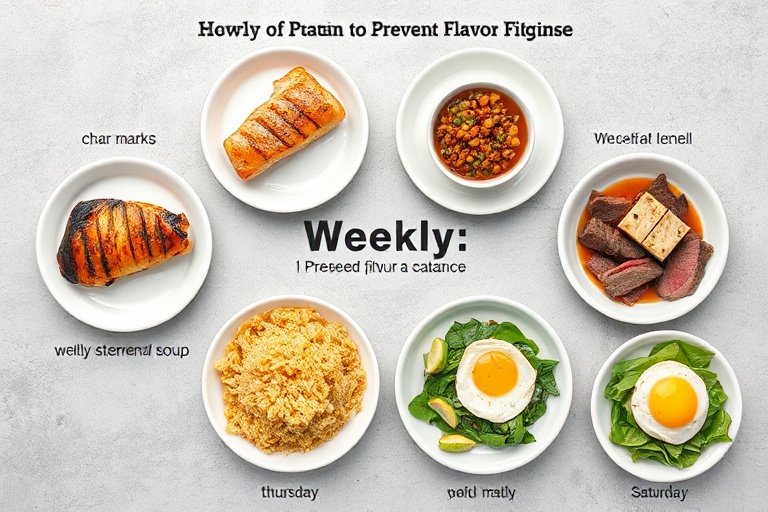
Monday: Grilled Chicken (radiation heat, high heat) Tuesday: Boiled Salmon (conduction heat, low heat) Wednesday: Freezer backup - Lentil Soup (convection heat, simmering) Thursday: Stir-fried Tofu (conduction heat, high heat) Friday: Roasted Beef (radiation heat, high heat) Saturday: Freezer backup - Vegetable Paella (convection heat, simmering) Sunday: Poached Eggs with Spinach (conduction heat, low heat)
As you can see, MealSolved's 2+1 system exposes your taste buds to a variety of flavors and cooking methods, preventing flavor fatigue while maintaining the convenience of meal planning.
Sources
[1] Physics of Cooking: Heat Transfer and Nutritional Retention - Journal of Food Engineering
[2] Sensory-specific satiety, the variety effect, and physical context: Does change of context during a meal enhance food intake? - The Center for Nutritional Psychology
[3] Effects of different thermal cooking methods on the characteristic taste and flavor compounds of Solen grandis meat - LWT - Food Science and Technology
[4] Meal Repetition Study - Rolling Out