The Thermonuclear Time Bomb In Your Freezer How Temperature Cycling Destroys Food Quality And Why Mealsolveds Freezer Breaker Strategy Defuses It Through Scientific Strategic Rotation
Learn how temperature cycling silently degrades your frozen food's quality, taste, and nutrients. Discover MealSolved's scientific 2+1 rotation strategy to defrost waste and preserve freshness.
The Thermonuclear Time Bomb in Your Freezer: How Temperature Cycling Destroys Food Quality and Why MealSolved's "Freezer-Breaker" Strategy Defuses It Through Scientific, Strategic Rotation

**
Introduction
In the heart of your home, a silent, invisible enemy is at work, slowly undermining your grocery budget and sabotaging your healthy eating plans. It's not a mouse or a leaky pipe—it's the temperature cycling in your freezer, a relentless force that's degrading your food's quality, nutrients, and flavor over time. This is the thermonuclear time bomb in your freezer, and it's high time we defused it with a strategic, scientific approach.
The Silent Destroyer: Temperature Cycling in Your Freezer

**
Every time you open your freezer door, you're not just letting out a cool gust of air—you're triggering a chain reaction that degrades your frozen food. As TempCube explains, exposure to temperatures outside their ideal range can cause wilting, texture loss, and nutrient degradation—exactly what happens when your home freezer cycles between -10°F and 5°F every time the door opens. This process, known as thermal cycling, is the silent destroyer of food quality in your home.
The Science Behind the Degradation
At the heart of this issue lies a simple fact of physics: water expands as it freezes. When your freezer's temperature fluctuates, ice crystals in your frozen food grow and recrystallize, rupturing cell walls in proteins and vegetables. This microscopic damage leads to macroscopic changes—your once-crisp vegetables turn soggy, and your carefully portioned proteins become freezer-burned and dry.
The Hidden Cost of Door Openings
But how significant is this problem, really? According to a study by TempCube, the average American opens their freezer door 15 times a day. Each of these openings causes a measurable temperature fluctuation, leading to cumulative damage over time. In just one week, these openings can result in noticeable quality loss, and over weeks and months, the degradation becomes severe enough to render food inedible.
The Economic and Environmental Impact of Freezer Failure

**
The consequences of this freezer failure aren't just culinary—they're economic and environmental. According to the 2026 ReEncle Food Waste Report, household food waste costs the American economy $408 billion annually, with the average family of four throwing away $1,500 worth of food each year. Much of this waste begins as frozen items that degrade to inedible quality due to temperature cycling. In fact, 30-40% of the U.S. food supply is wasted, with frozen items being a significant but preventable contributor.
The Nutritional Conundrum: Frozen Food's Double-Edged Sword
Frozen food can be a boon for home cooks, preserving nutrients and extending shelf life. However, this benefit is a double-edged sword. While a study published in the National Library of Medicine found that the vitamin content of frozen commodities was comparable to and occasionally higher than that of their fresh counterparts, this is only true when ice crystal formation is minimized. Unfortunately, this is exactly what temperature fluctuations destroy.
The Vitamin Retention Time Bomb
Over time, the gradual degradation of frozen food through temperature cycling reverses the nutritional benefits of freezing. Vitamins C and β-carotene, for example, degrade over time due to improper storage, leading to a net loss in nutritional value. This means that while frozen food can be a convenient and nutritious option, it's only if it's managed properly.
The Anti-Pattern: Why Traditional Meal Planning Fails
Traditional meal planning systems often fail to address the freezer management aspect, treating it as a black box. They ignore the temperature cycling that degrades carefully prepared meals, leading to waste and disappointment. Most meal prep systems don't account for the psychological reality that eating identical meals multiple days in a row isn't appealing to most people. This leads to a vicious cycle of waste and frustration.
MealSolved's "Freezer-Breaker" Strategy: Defusing the Time Bomb
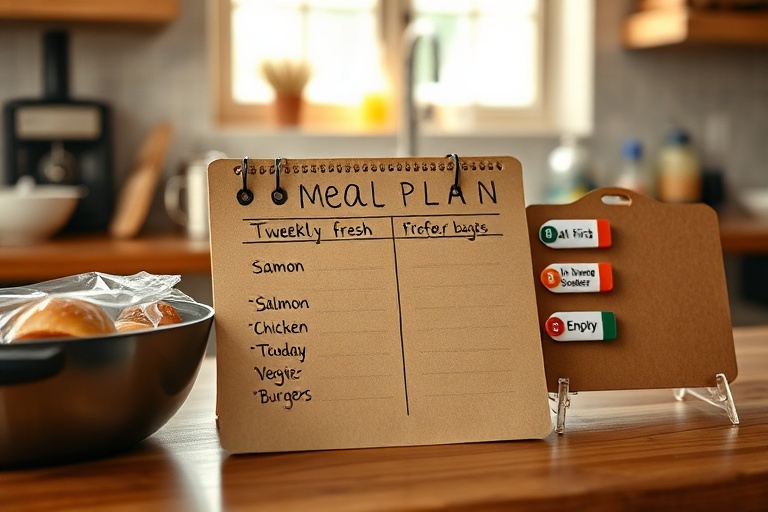
**
MealSolved's 2+1 strategy isn't just about convenience—it's a scientifically necessary rotation that ensures frozen items are consumed before cumulative temperature cycles destroy their quality. Here's how it works:
1. The 2+1 System: Variety Through Strategic Planning
By planning around two fresh core proteins and one freezer-breaker, you ensure variety in your meals while minimizing shopping trips and waste. This strategic planning approach addresses both the variety problem and the freezer degradation problem.
2. Kanban for Kitchens: Visual Management for Freezer Inventory
Inspired by Lean Six Sigma principles, MealSolved's system implements a Kanban approach to freezer inventory management. By using a visual management system, you can minimize waste and prevent frozen items from getting buried and forgotten, experiencing repeated temperature cycles that degrade their quality.
3. Minimizing Wasted Motion: The Search for the Lost Freezer Item
Every time you search for a forgotten freezer item, you're exposing it to additional temperature fluctuations. By using a Kanban system, you minimize these searches, preserving the quality of your frozen food.
Key Takeaway: Strategic Rotation is the Key to Freezer Success
"Temperature cycling is the silent enemy in your freezer, but with strategic rotation and visual management, you can defuse the time bomb and keep your frozen food fresh, nutritious, and delicious."
Pro Tip: Monitor and Maintain Your Freezer's Temperature
To minimize temperature fluctuations, make sure your freezer is well-insulated and set to the correct temperature (-18°C or 0°F). Regularly defrost your freezer to maintain its efficiency, and consider using a freezer thermometer to monitor its temperature.