
The Cognitive Economics Of Meal Planning Strategic Investments For Household Productivity
Meal planning isn't just about food—it's about managing your mind's most valuable resource. Learn how to transform mental labor into strategic investment.
The Cognitive Economics of Meal Planning: Strategic Investments for Household Productivity
Meal planning isn't just about saving time and reducing food waste—it's about optimizing your most valuable resource: cognitive bandwidth. In today's fast-paced world, every meal decision carries an implicit opportunity cost, extending far beyond immediate financial implications. This cognitive burden, often invisible yet disproportionately borne by women, represents a significant yet unmeasured contributor to the gender wage gap and household productivity loss. By adopting a strategic approach to meal planning, such as the 2+1 Strategy, you can transform this recurring mental expense into a strategic investment that yields compounding cognitive dividends.
The Hidden Costs of Meal Planning: Cognitive Opportunity Losses
Every day, home cooks face a daunting challenge: deciding what's for dinner. While this may seem like a simple task, it's part of a larger issue of cognitive economics—the study of how we allocate our mental resources. Each meal decision carries an opportunity cost, representing the mental energy that could have been allocated to other pursuits (Schulze et al., 2025).
This cognitive burden is often invisible yet significant. A 2026 Russell Sage Foundation research grant explores the economic consequences of "invisible household labor"—the cognitive, emotional, and managerial tasks essential to household functioning. The researchers found that women are significantly more likely to report that engaging in these tasks lowers their life satisfaction and increases stress levels (Gee et al., 2026).
Moreover, traditional time-use metrics fail to capture the true burden of meal planning because they only measure execution time, not the anticipatory cognitive labor. A 2025 IZA Discussion Paper introduces a novel methodology to measure individual perceptions of mental load, demonstrating that invisible labor often fails to be acknowledged in relationships (Reinholz Research, 2025).
Meal Planning as a Household Production Optimization Problem
Economist Gary Becker's Household Production Model teaches us that time is as valuable as money. Households are not just consumers; they are mini factories combining time, skills, and goods to create utility (Becker, 1965). Strategic meal planning allows households to optimize their most valuable resource—cognitive bandwidth—for higher-value pursuits.
Consider the cognitive transaction costs of deciding what to cook each night. These costs increase with decision complexity, making ad-hoc meal planning inefficient (Schulze et al., 2025). In contrast, structured meal planning simplifies decision-making, reducing cognitive transaction costs and freeing up mental energy for other activities.
The 2+1 Strategy: A Cognitive Capital Management System
The 2+1 Strategy operates as a cognitive capital management system, transforming meal planning from a recurring mental expense into a strategic investment. Here's how it works:
- Plan around two fresh core proteins: This simplifies grocery shopping and reduces decision fatigue. It also allows you to take advantage of bulk discounts, saving both time and money (ReFED/YouGov, 2026).

- Add one freezer-breaker: Having a backup plan ensures you're never caught off guard, reducing last-minute takeout orders and food waste. It also provides cognitive relief, knowing you have a safety net for busy weeks.

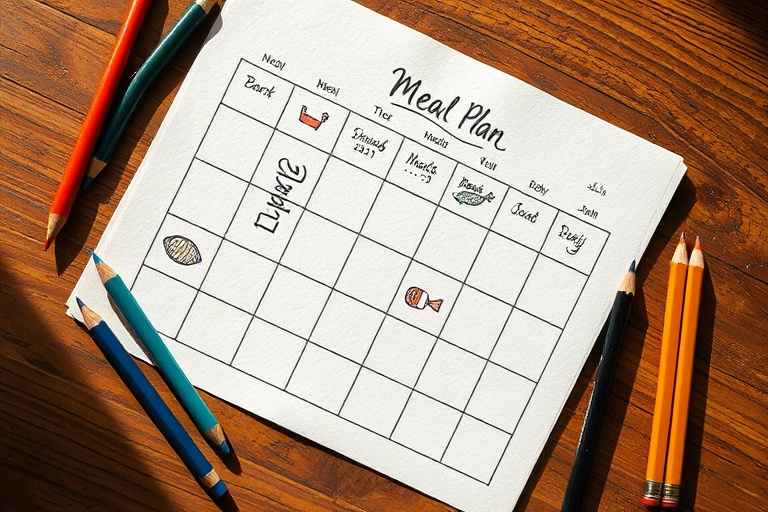
- Create a meal plan calendar: Visualizing your meals for the week makes it easier to see what ingredients you need and when. This further reduces cognitive load and simplifies grocery shopping.
Redistributing the Mental Load: The 2+1 Strategy in Action
Adopting the 2+1 Strategy not only reduces cognitive burden for the primary meal planner but also makes the mental load visible and redistributable. By creating a shared meal plan calendar, couples can see exactly what needs to be done and when, facilitating a more equitable division of labor.
Moreover, the 2+1 Strategy's emphasis on batch cooking and meal prep further reduces cognitive load. Once the initial planning is done, much of the work can be automated, freeing up mental energy for other tasks.
Key Takeaway: Strategic Meal Planning as an Economic Intervention
Meal planning isn't just about putting food on the table—it's about optimizing your household's most valuable resource: cognitive bandwidth. By adopting a strategic approach to meal planning, such as the 2+1 Strategy, you can reduce cognitive opportunity losses, redistribute the mental load, and invest in higher-value activities.
Pro Tip: Make meal planning a family affair. Involving everyone in the process not only reduces your cognitive burden but also teaches children important life skills and fosters a sense of shared responsibility.